






Refrigeration underpins critical industries including food production, pharmaceuticals, petrochemicals, data centres and leisure facilities. As extreme temperatures become more frequent, refrigeration resilience is becoming just as important as efficiency. This CPD article explores the engineering principles that help refrigeration systems continue delivering reliable cooling under high ambient conditions and provides practical guidance for engineers, plant owners and operators across all industrial refrigeration applications.
Recent exceptionally high temperatures placed parts of the UK’s cooling infrastructure under considerable pressure and prompted wider industry discussion about the resilience of refrigeration systems in a changing climate.
Comments from the UK Cold Chain Federation highlighted concerns that much of Britain’s refrigerated infrastructure was designed for lower summer temperatures, while calls for greater recognition of the cold chain as critical national infrastructure reinforced the essential role refrigeration plays in maintaining food security and supporting the wider economy.
Although many industrial refrigeration systems continued to operate reliably throughout the heatwave, the conditions highlighted an important engineering challenge. Refrigeration systems installed today are expected to remain in service for 25 to 30 years, during which time periods of prolonged high ambient temperatures are likely to become more frequent.
Design decisions therefore need to consider not only historical weather data -when periods above 30°C were relatively uncommon and prolonged heatwaves were considered exceptional- but also the conditions systems are expected to experience throughout their operational life.
For many years, refrigeration performance has largely been measured by efficiency. As ambient temperatures rise, maintaining sufficient cooling capacity during periods of extreme heat deserves equal consideration. Higher electricity consumption during hot weather is generally manageable, unlike running out of cooling capacity at peak demand.
For owners and operators of refrigeration systems, particularly those serving food manufacturing, temperature-controlled storage, pharmaceuticals, petrochemical facilities, ice rinks and data centres, resilience is becoming a defining characteristic of good refrigeration design.
The ability to maintain product temperatures during prolonged periods of extreme heat rarely depends on individual components or even the refrigerant itself. Instead, it is the result of the entire refrigeration system working as intended throughout its lifecycle, from the design, equipment selection and manufacture through to controls, commissioning, ongoing maintenance, optimisation and modernisation.
The recent heatwave has provided a timely reminder that refrigeration systems should no longer be assessed solely on how efficiently they perform under average operating conditions. Increasingly, they must also be capable of maintaining reliable cooling under foreseeable peak conditions.
Capacity resilience is becoming as important as efficiency
Traditionally, higher ambient temperatures were viewed primarily as an energy concern. Compressors worked harder, electricity consumption increased and system efficiency reduced.
Modern refrigeration systems, particularly those operating at low temperatures or using Carbon Dioxide (CO₂), present a different engineering challenge. As ambient temperatures rise, available cooling capacity can reduce significantly even where increases in electrical power appear relatively modest. In practical terms, this reduction in capacity can eventually result in the refrigeration system no longer being capable of meeting the site’s cooling demand. The initial result is an increase in chamber or product temperature, but pretty soon, there is the potential for the equipment to move outside its design operating envelope and a total loss of cooling.
While reduced efficiency increases operating costs, reduced cooling capacity can compromise product integrity, interrupt production, delay distribution and ultimately affect business operations.
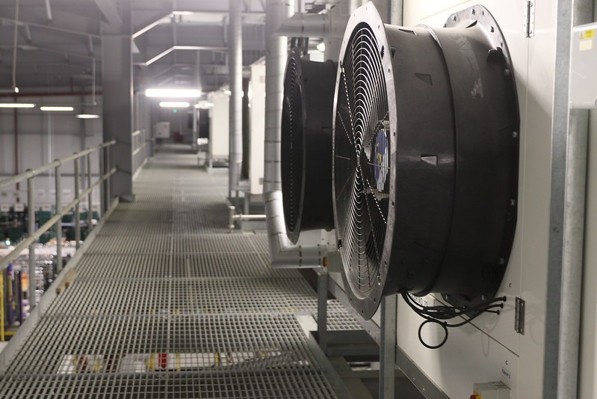
Evaporator units (air coolers) installed above a cold store
Refrigerant behaviour under high ambient conditions
Different refrigerants respond very differently to increasing ambient temperatures, making refrigerant selection an increasingly important consideration when designing systems expected to operate reliably throughout future heatwaves.
The table below shows the effect of a 10 degree rise in ambient temperature on two refrigerants widely used in industrial refrigeration applications.

The comparison shows that CO₂ systems experience a more significant reduction in available cooling capacity under high ambient conditions, making original design assumptions, heat rejection performance and ongoing maintenance increasingly important. Ammonia systems also consume more energy as temperatures rise but generally retain cooling capacity more effectively.
Carbon Dioxide (CO₂) systems are more sensitive to ambient conditions with 33% loss in cooling capacity. This means a greater risk of running out of cooling duty at peak conditions. Ammonia (NH₃) systems are more stable only experiencing a 5% loss under the same conditions. Their power use increases as the weather gets hotter, but they maintain capacity more effectively.
This should not be interpreted as one refrigerant being universally better than another. CO₂ offers excellent performance for some applications, particularly low temperature product freezing, while ammonia delivers efficient cooling over a wide range of temperatures. In many facilities, the two are successfully combined in cascade systems to take advantage of CO₂’s excellent low-temperature performance for product freezing alongside the robust heat rejection and high-temperature performance associated with ammonia.
The important consideration for designers is that refrigerant selection should reflect the full operating envelope of the plant, including increasingly frequent periods of extreme heat, rather than performance under average conditions alone.
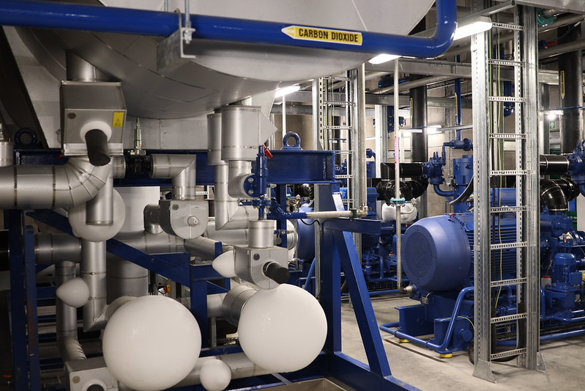
Cascade Ammonia / CO2 system – Star Refrigeration (cold storage and food manufacturing facility)
Heat rejection becomes the limiting factor
When refrigeration systems struggle during hot weather, the limiting factor is often not the compressor but the ability to reject heat.
Condensers and gas coolers become increasingly critical as ambient temperatures rise. Larger heat exchangers, and lower approach temperatures can improve resilience during periods of sustained high temperatures.
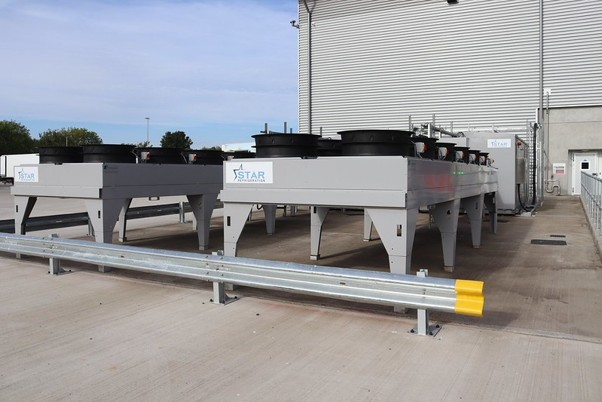
Condensers/gas coolers rejecting heat to the outside air at a CO2 temperature controlled storage facility
Performance can also deteriorate gradually over the life of the plant. Fouling, blocked coils, reduced airflow, poor maintenance or air recirculation may have only a limited effect under normal conditions but can significantly reduce available capacity during a heatwave.
Plant layout deserves equal attention. Positioning condensers or gas coolers away from direct solar gain on a north or shaded elevation and avoiding warm air recirculation while maintaining unrestricted airflow all help protect performance.
For CO₂ systems in particular, gas cooler performance can determine whether the system continues operating comfortably or approaches its design limits. Hybrid arrangements, ammonia/CO₂ cascade systems, thermal storage and intelligent load management may all provide additional resilience.
Designing for future climates rather than historical averages
Many refrigeration systems currently operating across the UK were designed using ambient design temperatures that reflected the climate at the time, some 20 or 30 years ago.
The challenge today is that refrigeration systems installed now are likely to remain operational for decades.
During that lifetime, peak summer temperatures are expected to become both higher and more frequent and grid conditions and energy prices are becoming more volatile.
Ambient temperatures of up to +40°C should be considered at the system design stage. Simply oversizing plant to increase cooling capacity is not necessarily the answer, however, as it can reduce efficiency during part-load operation for much of the year. Instead, engineers should seek an appropriate balance between seasonal efficiency and resilience under foreseeable peak conditions.
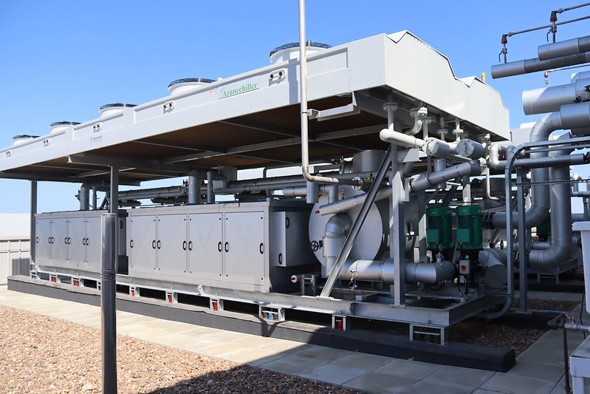
Air cooled, low-charge ammonia Azanechillers designed for temperatures of up to +40°C with fully integrated controls to preserve cooling capacity during prolonged periods of exceptionally high ambient temperatures
A refrigeration system that performs efficiently during average weather but reaches its operational limits during increasingly frequent heatwaves may no longer represent the optimum engineering solution.
Integrated controls can preserve valuable cooling capacity
Good refrigeration performance is determined by more than equipment selection alone.
Modern control strategies can play an important role in maintaining available cooling capacity during periods of extreme weather.
Rather than responding once temperatures have already increased, intelligent fully integrated controls which take account of all the components as a whole can anticipate changing conditions. Strategies such as reducing store temperatures ahead of forecast heat, optimising compressor sequencing, maximising heat rejection performance and managing refrigeration load proactively can all help preserve system capacity.
Weather forecasting integrated into advanced control platforms allows these adjustments to be made automatically before ambient temperatures reach their highest levels.
Viewed this way, controls become an important resilience tool rather than simply an energy management system.
Maintaining design performance throughout the system’s life
Even the best-designed refrigeration system will only continue delivering its intended performance if it is properly maintained.
As heat exchangers foul. airflow becomes restricted. control settings may begin to drift and fans power increases. Individually these changes may appear relatively minor, but together they steadily erode the design margins built into the original plant and extreme weather often exposes these hidden losses.
Seasonal preparation should therefore include cleaning condensers, gas coolers and evaporators, removing debris, checking airflow, verifying control strategies and reviewing plant performance before periods of high ambient temperatures arrive.
The commercial consequences of losing cooling capacity
From a business perspective, the cost of refrigeration failure extends well beyond electricity consumption.
A refrigeration plant operating slightly less efficiently during hot weather is manageable but running out of cooling capacity can interrupt production, compromise product quality, increase waste, affect customer service and business continuity.
Designing for resilience therefore represents not simply an engineering objective but a commercial one.
Key engineering considerations
As ambient temperatures continue to rise, refrigeration design should increasingly consider:
- selecting refrigerants based on full operating performance rather than nominal efficiency alone;
- prioritising available cooling capacity during peak ambient conditions;
- investing in robust heat rejection systems and maintaining them throughout the plant lifecycle;
- designing around future climate conditions as well as historical weather data;
- using intelligent controls to anticipate rather than react to extreme weather;
- recognising resilience as a core measure of refrigeration system performance alongside efficiency.
Efficiency isn’t the real risk. Running out of cooling capacity is.
Recent industry discussions have emphasized how refrigeration underpins modern infrastructure, from food manufacturing, cold storage and pharmaceuticals to petrochemical processing, data centres and leisure facilities.
The recent heatwave has reinforced that resilience deserves to sit alongside efficiency as one of the defining measures of refrigeration system performance.
With ambient temperatures continuing to rise, engineers and asset owners should increasingly focus on maintaining available cooling capacity alongside improving efficiency. Achieving this requires careful consideration of refrigerant selection, heat rejection, control strategy, maintenance and the assumptions used when sizing new systems.
Many refrigeration systems installed today will still be operating well into the middle of this century. Designing them around yesterday’s climate risks creating avoidable operational challenges tomorrow.
Ultimately, the true measure of a refrigeration system is not only how efficiently it performs on an average summer day, but how reliably it continues to protect products, support operations and maintain cooling under all foreseeable operating conditions.
This article has been certified by the International CPD Certification Service as CPD compliant. To obtain your Continuous Professional Development Diploma, please email cpdcertificate@star-ref.co.uk